Last updated: September 2026
If you want the short answer from the people who study nail damage for a living: the American Academy of Dermatology recommends gel over acrylic. Their reasoning is specific — gel is more flexible than acrylic, which means your own nail underneath is less likely to crack.
That is not the whole story though, because gel carries its own trade-offs and acrylic still wins on some jobs. This guide sets out what each system actually is, how they compare on durability, damage, removal, cost and upkeep, what dermatologists advise on top of the choice itself, and how to protect your natural nails whichever you pick.
What Each One Actually Is
Gel
A gel product is painted on and then cured — hardened under a lamp. That covers several different things sold under the same word: gel polish over your natural nail, builder gel used as a strengthening overlay, and soft gel tips applied as extensions. What they share is the curing step and a finish that stays glossy for weeks rather than days.
Acrylic
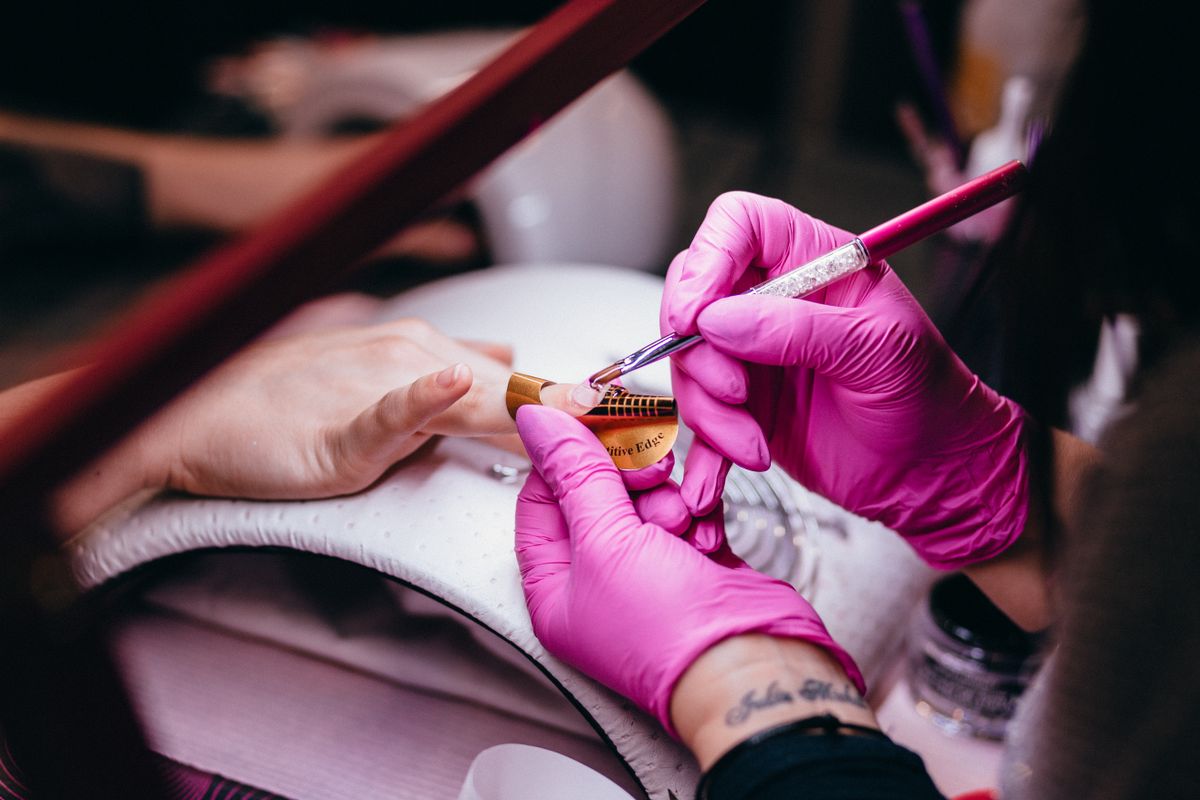
Acrylic is a liquid monomer mixed with a powder polymer that hardens in the air, with no lamp needed. It is sculpted onto the nail, usually over a tip or a form, and sets hard. It is the traditional route to real length and dramatic shapes, and it is the more repairable of the two when a nail breaks.
Side by Side
| Gel | Acrylic | |
|---|---|---|
| How it hardens | Cured under a lamp | Air-hardens as it is sculpted |
| Feel | More flexible | Harder and more rigid |
| Finish | Naturally glossy | Needs buffing or a top coat for shine |
| Length and drama | Good, with tips or builder gel | Better for real length and sculpted shapes |
| Repairing a break | Harder — often a redo of that nail | Easier — a skilled tech can rebuild it |
| Removal | Soak-off types dissolve in acetone | Soaking, and often filing too |
| Odour during application | Minimal | Noticeable monomer smell |
| Typical published price | $25–$70 for gel; $45–$85 for builder gel | $30–$130 for a full set |
| Upkeep | Infills or redo every 2–3 weeks | Infills every 2–3 weeks |
The flexibility row is the one that matters most, and it is the reason the dermatological advice lands where it does.
What Dermatologists Actually Recommend
The AAD’s guidance on artificial nails is unusually concrete, and it goes further than simply naming a winner.
- Choose gel over acrylic. Gel can still cause brittleness and cracking, but it is more flexible, so your own nails are less likely to crack.
- Ask for soak-off gel rather than the kind that has to be filed off. Filing is where a lot of the damage happens.
- Ask for an LED curing light rather than a UV one, to reduce radiation exposure.
- Do not let anyone trim your cuticles. Cuticles protect the nail and surrounding skin from infection.
- Keep artificial nails for special occasions, so natural nails get recovery time between sets.
On gel manicures specifically, the AAD notes they can cause nail brittleness, peeling and cracking, and that repeated UV exposure during application can increase the risk of skin cancer and premature ageing on the hands. Their advice is to apply a broad-spectrum, water-resistant sunscreen of SPF 30 or higher to your hands beforehand, or to wear dark gloves with the fingertips cut out during the appointment.
Three things to ask for at the desk
Soak-off gel rather than file-off. An LED lamp rather than UV. And no cuticle trimming — pushing back is fine, cutting is not. None of these costs extra, and together they remove most of the avoidable damage from a gel appointment.
Where the Damage Actually Comes From
People tend to blame the product. The AAD points at the process.
Filing the natural nail to prepare it for acrylic thins it and makes it weaker. Chemical exposure during application and removal adds to that. And frequent touch-ups can seriously damage natural nails, eventually leaving them thin, brittle and parched.
That reframes the whole comparison. The question is not only gel or acrylic, but how much filing your technician does, how the set is removed, and how often you are back in the chair. A gently applied acrylic set removed properly does less harm than an aggressively filed gel set picked off at home.
It is also why the cheapest, fastest appointment is not always the bargain it looks like. Time in the chair is partly time spent being careful.
Removal: The Step That Decides Everything
Whichever system you choose, removal is where most avoidable damage occurs — and it is the step people most often try to do themselves at 11pm with their fingernails.
The AAD’s advice for gel removal is to soak only the fingertips in acetone rather than the whole hand, to protect the surrounding skin. A gentler method they suggest is acetone-soaked cotton balls wrapped in foil around each fingertip for about 15 minutes.
Two things follow from that. First, ask for soak-off products at the point of application, because you are deciding your removal method weeks in advance. Second, budget for professional removal — published prices run roughly $9 to $20 for gel and $15 to $25 for acrylic — rather than treating it as an optional expense. Peeling a set off takes the top layer of the nail plate with it, and that takes months to grow out.
Cost and Upkeep Compared
Published 2026 figures put gel manicures at roughly $25 to $70, builder gel overlays at $45 to $85, and acrylic full sets anywhere from $30 to $130 depending heavily on the market. Infills for either sit well below a new set, commonly $18 to $45.
The monthly number matters more than the appointment price, since both systems need attention every two to three weeks as the nail grows out. Our full nail salon price guide breaks the ranges down service by service, including removals and nail art.
One practical difference: acrylic is generally easier and cheaper to repair when a single nail breaks, because a skilled technician can rebuild it. With gel, a broken nail more often means redoing that nail entirely.
Allergies and Product Safety
Both systems are built on methacrylate chemistry, and the FDA notes that traces of the reactive monomers can cause an adverse reaction in sensitive people — redness, swelling and pain in the nail bed.
On acrylic specifically, the FDA removed methyl methacrylate (MMA) products from the market in the 1970s after injury complaints, while ethyl methacrylate (EMA) remains permitted. MMA is considerably cheaper, which is why it occasionally turns up in unusually low-priced work — a fair reason to ask any salon what products it uses.
The FDA’s general guidance for nail products is to follow the label directions, ensure good ventilation while they are being used, avoid skin contact with certain ingredients, read the warning statements, and report adverse reactions. If you have a known sensitivity to formaldehyde or to toluene sulfonamide/formaldehyde resin, read ingredient labels.
So Which Should You Choose?
- Your natural nails are thin or already damaged. Gel, soak-off, on an LED lamp — and consider a builder gel overlay at natural length rather than extensions.
- You want serious length or a sculpted shape. Acrylic still does this better, and repairs better when one breaks.
- You are hard on your hands. Acrylic’s rigidity holds up, but a break can be worse when it happens; keep the length short whichever you choose.
- You want the most natural look. Gel, kept at your own length.
- You are sensitive to smells, or pregnant and avoiding fumes. Gel has far less odour; either way, ask about ventilation.
- It is a one-off for an event. Either works. This is exactly the “special occasions” use the AAD is comfortable with.
- You want to wear them permanently. This is the case where the answer is really “neither, continuously” — build in breaks.
Protecting Your Nails Either Way
The AAD suggests taking a one to two week “nail polish holiday” between applications so nails can repair, and applying a moisturiser such as petroleum jelly to nails and cuticles several times a day in between to reduce brittleness and chipping.
Alongside that: sunscreen on the hands or fingerless gloves before curing, never peel a set off, keep the length modest, and if a technician is filing hard enough to generate heat, say so. Discomfort during filing is information, not something to sit through politely.
Frequently Asked Questions
Sources
- American Academy of Dermatology — Artificial Nails: Tips for Reducing Nail Damage
- American Academy of Dermatology — Gel Manicures: Tips for Healthy Nails
- US Food and Drug Administration — Nail Care Products
Whichever you choose, the salon matters as much as the system — our guide to choosing a nail salon covers the tool, footbath and filing questions that decide how much damage an appointment actually does.
Run a nail salon? If you work soak-off, use LED lamps and refuse to cut cuticles, a free Ypages listing puts you in front of clients looking for exactly that. Add your business free.
This article summarises published guidance from dermatology and regulatory bodies. If you have a persistent nail problem, a reaction to a product, or an infection, see a dermatologist or your doctor.