Last updated: September 2026
You can learn more about a repair shop in one phone call than from a hundred online reviews, provided you ask the right things. The questions below are ordered the way a real conversation runs, and each one comes with what a good answer sounds like and what should make you pause. One of them has to be asked before you authorise any work rather than afterwards, because asking later is too late — that is question eight, and it is the one almost nobody knows about.
- 1. Are You Licensed, and Can I See Your Number?
- 2. Who Will Actually Work on My Car, and What Are Their Qualifications?
- 3. How Do You Charge for Labour?
- 4. Is There a Diagnostic Fee, and Is It Credited Against the Repair?
- 5. Can I Have the Estimate in Writing Before Anything Starts?
- 6. What Happens if You Find More Problems Once You Start?
- 7. What Parts Will You Use, and Will the Invoice Say Which?
- 8. Will You Return the Parts You Replace?
- 9. What Is the Warranty, in Months and Miles, on Parts and on Labour?
- 10. Which of These Items Is Safety-Critical Today?
- 11. How Long Will It Take, and How Do I Get Around?
- One Extra Question, if the Job Involves Air Conditioning
- What to Check on the Invoice Afterwards
- Frequently Asked Questions
- Sources
1. Are You Licensed, and Can I See Your Number?
Requirements vary by state, but where licensing exists it is verifiable and the shop should know its number without hunting for it. California, for example, requires the final invoice to carry the shop’s name, address and licence number, and the state’s licence lookup lets you confirm it independently.
Good answer: the number, immediately, plus where to verify it. Bad answer: vagueness about whether their state requires one. They would know.
2. Who Will Actually Work on My Car, and What Are Their Qualifications?
The Bureau of Labor Statistics lists the typical entry route for automotive service technicians as a postsecondary nondegree award, and notes that employers may require or prefer certification, with some paying for their technicians to earn it. So certification is a choice a shop makes, and a shop that invests in it is telling you something.
Ask specifically whether the person touching your car is certified, and whether they have worked on your make and model before. A hybrid, a diesel or a European car can need brand-specific diagnostic software that a generalist shop may not have.
Good answer: a named technician, their certifications, and honest limits — “we see a lot of those, but for the transmission electronics we’d send you to a specialist”. Bad answer: “all our guys are experienced”, with no specifics.
3. How Do You Charge for Labour?
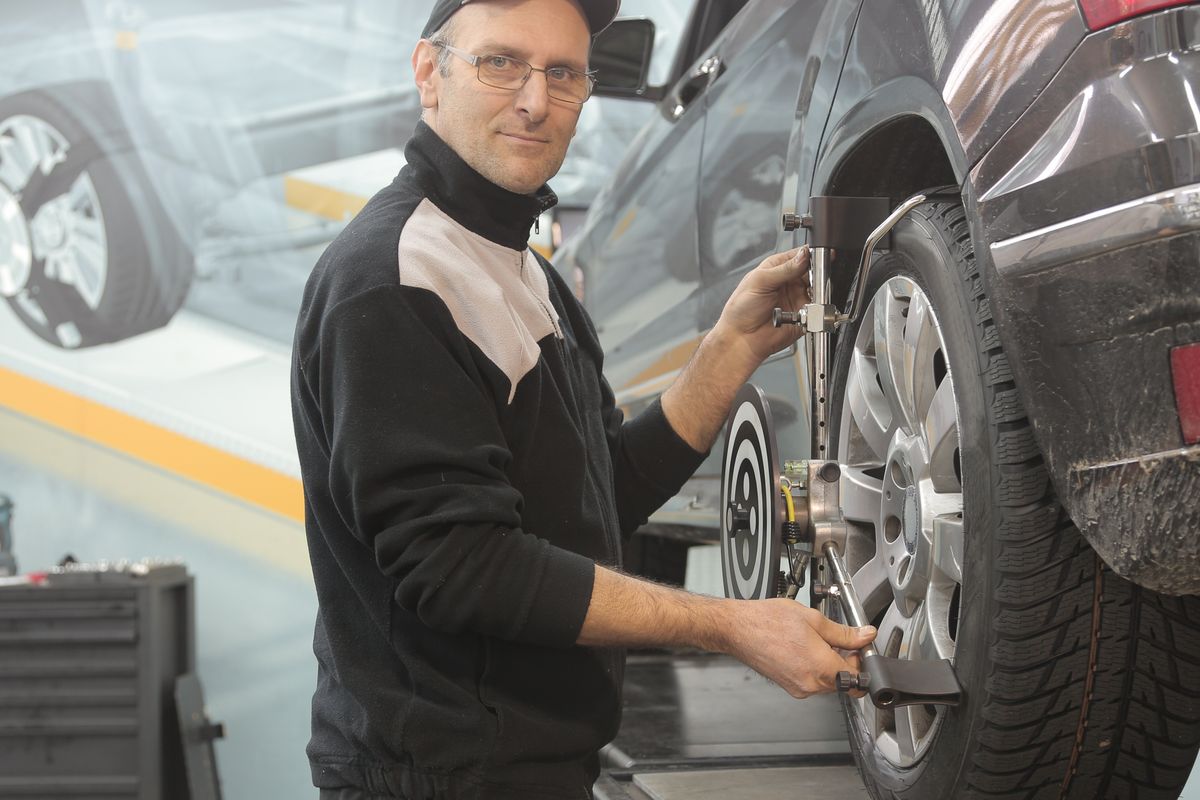
This is the question that explains most confusing invoices, and it has a genuinely surprising answer. BLS notes that some repair shops pay technicians on an hourly basis, while others pay them based on the amount of work completed.
The two billing models, side by side
| Billed by actual time | Billed by standard job time | |
|---|---|---|
| What you pay for | The hours the car was actually worked on | The time the job is allowed, whatever it takes |
| If the job runs long | You pay more | You pay the same |
| If it goes quickly | You pay less | You pay the same |
| What to ask | What is the hourly rate? | How many hours is this job booked at? |
That second model is why a job can be billed at two hours when the car was only on the lift for ninety minutes: the charge is based on the standard time allowed for that job rather than a stopwatch. It is not necessarily unfair — it cuts both ways, and it means you are not penalised when a bolt shears — but you should know which model you are being quoted under. For context on rates generally, BLS puts the median pay for automotive service technicians and mechanics at $50,620 a year, or $24.34 an hour, as of May 2025, which is the wage inside a shop’s much higher billed rate.
Good answer: a clear explanation of the model and the hourly rate. Bad answer: reluctance to state a rate at all.
4. Is There a Diagnostic Fee, and Is It Credited Against the Repair?
Diagnosis is real work — often the most skilled part of the job — and charging for it is legitimate. What varies is whether the fee is absorbed into the repair if you go ahead. Two shops quoting similar labour rates can end up far apart once a non-credited diagnostic fee is counted.
Good answer: a figure, and a clear yes or no on crediting. Bad answer: “we’ll sort that out later”.
5. Can I Have the Estimate in Writing Before Anything Starts?
California’s rule is a good benchmark wherever you live: the shop must give you an estimate showing the expected cost of the work, before work begins. A verbal number is not something you can hold anyone to later.
Good answer: handed over or emailed without being chased. Bad answer: “we can’t know until we open it up” — which is sometimes true of the final figure, and never true of the diagnostic cost and the authorisation limit.
6. What Happens if You Find More Problems Once You Start?
This is where estimates turn into invoices you did not expect. California requires that if the shop finds more problems after starting, they must contact you, and you must authorise any additional repairs.
Whatever your state requires, get the practice agreed in advance: name a figure above which they must phone you, and confirm which number they will call. A shop that volunteers this before being asked is one that has had the awkward conversation before and does not want to have it again.
Good answer: “we’ll call you before we exceed X, and we won’t touch anything until you say so”. Bad answer: “we just do what needs doing”.
7. What Parts Will You Use, and Will the Invoice Say Which?
Original equipment, aftermarket, reconditioned and used parts carry very different prices, and you are entitled to know which you are buying. California requires the invoice to list all parts supplied and to indicate which are used, reconditioned or rebuilt — a useful standard to ask for anywhere.
Good answer: the type named up front, with the price difference explained and a reason for the recommendation. Bad answer: “we use quality parts”, which is not an answer to the question asked.
Can I supply my own parts?
Sometimes, and the answer tells you something either way. Many shops decline, and the reason is usually legitimate rather than greedy: they cannot warranty a part they did not source, so a customer-supplied part typically means labour-only cover. If a part fails, you pay the labour again. A shop that says yes but explains that limit is being straight with you. A shop that refuses outright and cannot say why is protecting a parts margin rather than a warranty.
8. Will You Return the Parts You Replace?
Here is the one with a deadline. California’s guidance is explicit: you can ask the shop to return any parts they replaced, and you should ask for those parts before authorising the repairs.
Why it works even if you never look in the bag
The point is not that you want a box of oily components. It is that asking changes what happens in the workshop, and it gives you something concrete if the repair is later disputed. An honest shop finds the request completely unremarkable.
Good answer: “of course, we’ll bag them for you”. Bad answer: irritation, or an explanation of why that is not possible on a job where it obviously is.
9. What Is the Warranty, in Months and Miles, on Parts and on Labour?
There is no standard warranty on repairs, which means this is a genuine point of comparison between shops rather than a formality. Ask for both figures and both categories, because a parts-only guarantee leaves you paying the labour twice if the part fails.
| Ask | Why it matters |
|---|---|
| How many months, and how many miles? | Whichever comes first is what actually applies |
| Parts only, or parts and labour? | A failed part refitted free is a very different promise |
| Is it honoured here only, or nationwide? | Matters if you travel, or move |
| Is it in writing on the invoice? | A spoken guarantee is not enforceable later |
Good answer: specific numbers, in writing. Bad answer: “we stand behind our work”, with no terms attached.
10. Which of These Items Is Safety-Critical Today?
When a routine service comes back with a list of six recommendations, this question does more work than any other. It separates what genuinely cannot wait from what is simply due at some point, and it invites the shop to be honest rather than to sell the whole list.
And ask them to explain it in plain language
Whatever is on the list, ask for the reasoning in ordinary words — what is failing, what happens if it is left, and how they know. This is not a comprehension test for you. It is one for them. A technician who genuinely understands a fault can explain it to a non-specialist in a minute. Someone who retreats into jargon is either unwilling to be questioned or less certain than they sound.
The follow-up that does the real work
Follow it with “and what would you do if it were your car?” A good technician will happily tell you to defer two of the six. Someone who insists all six are urgent has told you how they work.
Good answer: a clear split into now, soon and eventually, with reasons. Bad answer: everything is urgent, and there is a discount if you decide today.
11. How Long Will It Take, and How Do I Get Around?
Two questions in one, because the answers are linked and both get forgotten at the counter. A repair can run from a couple of hours to over a week, and the variable is often parts availability rather than the work itself.
Ask the timeline and ask specifically whether any part has to be ordered in, because that is where the multi-day delays come from. Then sort out transport before you hand over the keys. Many independent shops run a courtesy shuttle within a five to ten mile radius; dealerships more often provide loaners, particularly on warranty work; some shops have rental arrangements that cut the daily rate roughly in half.
There is a practical reason to settle this early rather than late. If you are stranded in a waiting room with no way home, you will be tempted to hurry the technician — and a rushed repair is the one you come back for.
Good answer: a realistic window, a note on which parts are in stock, and a transport option offered before you ask. Bad answer: “should be done today” with no mention of parts.
The follow-up nobody thinks to ask
What happens if the car is ready and you cannot collect it that day? Some shops charge overnight storage. Others allow 24 to 48 hours. Some are closed at weekends, which turns a Friday finish into a Monday collection. None of this is unreasonable, and all of it is cheaper to know in advance than to discover at the till.
One Extra Question, if the Job Involves Air Conditioning
Air conditioning work has a federal requirement behind it that most drivers have never heard of. Under Section 609 of the Clean Air Act, any person who repairs or services a motor vehicle air conditioning system for consideration — payment or bartering — must be certified. Certification requires completing an EPA-approved training programme and passing an examination, covering the proper use of servicing equipment, the applicable regulatory requirements, the importance of refrigerant recovery, and the effects of improper refrigerant handling.
What that means for your quote
So if you are quoted for an A/C recharge or repair, asking whether the technician holds Section 609 certification is not a pedantic question. It is asking whether the person is legally permitted to do the job.
What to Check on the Invoice Afterwards
The questions get you a fair deal going in. The invoice is where you confirm you got it. California’s requirements make a good checklist to apply anywhere.
- The shop’s name, address and licence number.
- A list of all repairs performed, including any work done at no charge.
- A list of all parts supplied, indicating which are used, reconditioned or rebuilt.
- The total cost for parts and labour, itemised rather than lumped together.
- The warranty terms, written on the document rather than promised.
Compare it against the estimate line by line before paying. Differences are not necessarily wrong — additional work you authorised will show up — but every difference should be one you remember agreeing to.
If something is not right, California’s Bureau of Automotive Repair takes complaints and will look into the issue and help mediate a resolution; most states have an equivalent route through the Attorney General or a consumer protection agency. For the wider process of shortlisting a shop in the first place, including the free recall check worth doing before you spend anything, see our guide to finding a good mechanic you can trust. The same approach works on other trades — we use it for questions to ask before hiring an electrician, where a bad hire has consequences of a different kind.
Frequently Asked Questions
Sources
- California Bureau of Automotive Repair — Maintenance and repairs: your rights
- Bureau of Labor Statistics — Automotive Service Technicians and Mechanics
- US Environmental Protection Agency — Section 609 Technician Training and Certification
- Federal Trade Commission — Auto Repair Basics
Run a repair shop? If these are questions you already answer this way, a free Ypages listing puts you in front of the people asking them. Add your business free.
This article is general information, not legal advice. Repair shop rules and consumer protections vary by state — California’s are cited as a concrete example, so check what applies where you live.