

Last updated: September 2026
Landscaping is unusual among home services because it spans two very different trades. Cutting grass and pulling weeds is maintenance. Installing irrigation, building a retaining wall, laying a patio or planting mature trees is construction — and it comes with licensing thresholds, underground utilities and specialist credentials that mowing never touches. Most disappointing landscaping jobs come from hiring someone excellent at the first thing to do the second. This guide covers how to tell which one you need, the free call that has to happen before anyone digs, and the credentials you can actually verify.
Work Out Which Trade You Actually Need
California’s Contractors State License Board draws the line more clearly than most, and its framing is useful anywhere: routine yard upkeep is one thing, and construction is another.
Maintenance against installation
| Type of work | Examples | What it usually requires |
|---|---|---|
| Routine maintenance | Mowing, weeding, shrub trimming, leaf clearance | Often no licence, depending on state and job value |
| Planting and soft landscaping | Beds, shrubs, turf, mature trees | Digging, so a locate request first |
| Irrigation | Sprinkler systems, drip lines, controllers | Treated as construction in many states |
| Hardscaping | Patios, paths, retaining walls, decking | A licensed contractor, and often permits |
| Tree work | Pruning, removal, crown reduction | A separate specialist credential |
| Chemical treatment | Weed control, fertilisation programmes | A certified pesticide applicator for restricted products |
Once you know which rows your project covers, the shortlist writes itself — and you stop wasting time getting quotes from firms that cannot legally do half the work.

The Licence Threshold Nobody Mentions
Licensing rules vary by state, but the structure is usually the same: past a certain job value, the work needs a licensed contractor rather than a gardener.
California is a clear example. Its rule is that any construction project of $500 or more in combined labour and material costs requires a state-licensed contractor. Landscaping contractors there hold a C-27 specialty licence. A gardener doing routine upkeep generally does not need one — provided the work stays under that threshold and does not include construction elements such as artificial turf, irrigation systems or vinyl pool liners.
That threshold is lower than people expect. A modest irrigation repair or a small patio clears $500 easily, which means the friendly gardener who has cut your grass for three years may not be the right person to install it — not because of skill, but because of what they are licensed to do and what recourse you have if it goes wrong.
Verify the licence, do not take the number on faith
California publishes a licence lookup and a phone line for exactly this. Whatever state you are in, find the equivalent board rather than trusting a number printed on a truck, and confirm the licence is current and held under the name you are contracting with.
Before anyone puts a spade in the ground: 811
811 is the free national before-you-dig service, and it applies to homeowners and professional contractors alike. Anyone planning to dig should contact it a few business days beforehand — including for jobs as small as planting trees and shrubs or installing fences and mailboxes, because shallow digging is still digging. You give the address, county, nearest cross street, project type and the exact area, and utilities respond by marking their underground lines with paint or flags so the crew can dig carefully around them. Failing to do it is the number one cause of utility damage, running to roughly $30 billion a year in repairs and societal impacts. Ask your landscaper whether they have filed the request, and do not accept “we’ll be careful” as the answer.
Who files it, and how long it takes
Notice periods are set by state and commonly run to two full business days, excluding weekends and public holidays — so this is a conversation to have when the job is booked, not the morning the crew arrives.
Whose duty it is also varies. New York places the obligation on the contractor or excavator, even for work on private property. Colorado 811 addresses homeowners directly and puts it plainly: do not simply rely on your landscaper — if there is any doubt, contact 811 yourself. Either way, settle it in writing before work starts, and ask for the ticket number once it is filed.
The lines 811 will not mark
This is the part that catches people out, and it matters more in a garden than almost anywhere else.
811 marks public utility lines up to the meter. It does not mark anything on your side of it. Irrigation piping, the gas run to a fire pit or outdoor kitchen, low-voltage garden lighting, invisible dog fencing, and well or septic lines are all private, and all invisible to the locate request.
Those are precisely the things a landscaping crew is most likely to cut, because they sit shallow and they run exactly where new planting and new paving tend to go. A completed 811 request is not a guarantee that the garden is safe to dig — it only clears the utilities’ own lines.
So tell the company what is buried before anyone starts, and dig out the installation drawings if you have them. For a large project over unknown ground, a private utility locator is worth the fee, and far cheaper than a severed gas line.
Tree Work Has Its Own Credential
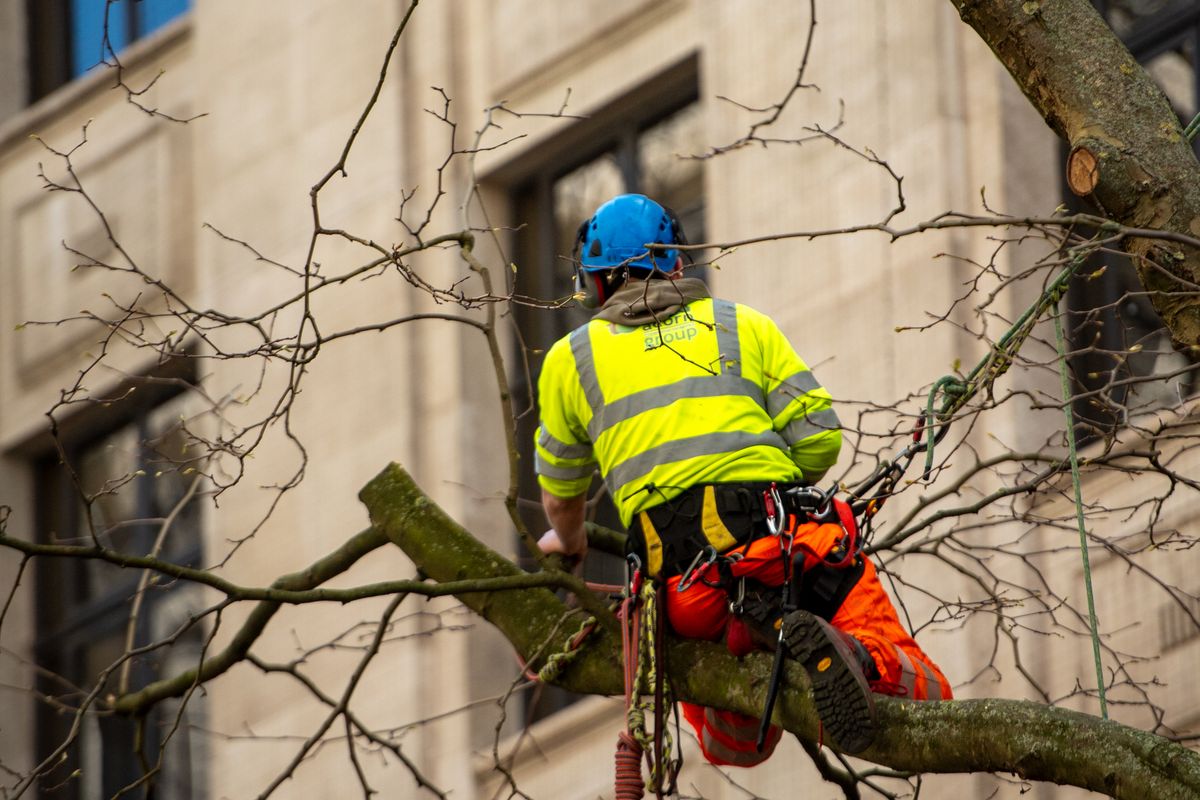
Pruning and removing trees is the most dangerous work that happens in a domestic garden, and it is a different discipline from planting and mowing. There is a recognised credential for it, and unlike a lot of industry badges it is earned rather than bought.
What ISA Certified Arborist involves
The credential is awarded by the International Society of Arboriculture. To be eligible, a candidate needs a minimum of three years of full-time experience in arboriculture — with a year counted as roughly 1,795 hours — or an accepted education substitute such as a four-year bachelor’s degree with at least four arboriculture-related courses plus one year of practical full-time experience.
The exam is 200 multiple-choice questions across ten knowledge domains, with 3.5 hours to complete it. Certification lasts three years, and holders must accumulate at least 30 continuing education units across that period and pay a recertification fee, or retake the exam. So it is a live credential rather than a one-off qualification from a decade ago.
For pruning a mature tree, reducing a crown near a roof, or any removal, this is the question to ask. A general landscaping crew with a chainsaw is not the same thing.
Money: Bids, Deposits and Payment
Landscaping projects are among the easiest home jobs to lose money on, because the work is highly variable and much of it gets buried.
The rules California sets out, worth applying anywhere
- Get at least three bids, and references from each bidder.
- Never pay more than 10 percent down or $1,000, whichever is less, unless the contractor has a blanket performance and payment bond on file with the board.
- Verify the bond and insurance, not just the licence.
- Avoid cash payments, which leave you no record and no dispute rights.
- Keep detailed project documentation throughout.
- Withhold final payment until the work meets every contract specification.
That deposit cap is the one to remember. A contractor asking for half up front on a $6,000 patio is asking for something California would not permit, and the logic behind the rule holds regardless of where you live: a large advance transfers all the risk to you.
Which insurance covers what
“Verify the insurance” is standard advice that rarely explains itself. There are three policies and they protect against different things.
| Cover | What it pays for | Why it matters to you |
|---|---|---|
| General liability | Damage to your property — a severed cable, a branch through a roof, a cracked window | Without it you pursue a small business for the repair, or absorb it |
| Workers’ compensation | Injury to their crew while working on your land | Landscaping is physical, outdoor, machinery-heavy work. If the company carries no cover, an injured worker’s route to recovery can run through you and your homeowner’s policy |
| Commercial auto | Trucks, trailers and towing | Relevant the moment a loaded trailer rolls into a fence or a neighbour’s car |
Ask for a current Certificate of Insurance rather than a verbal assurance, check the expiry dates, and confirm the company name on the certificate matches the company quoting you — subcontracting is common in landscaping and policies do not travel. Asking the insurer to send it to you directly takes one email and removes any question about whether the document is current.
Tree work deserves a separate question. A general landscaping liability policy does not necessarily extend to felling, and that is where the expensive accidents happen — so if removal is part of your job, ask whether the certificate covers it specifically.
What the written estimate should separate
- Design, if there is a design phase, and who owns the drawings.
- Site preparation and excavation, including spoil removal, which is often a surprise line.
- Materials, named by type and quantity rather than described as “quality materials”.
- Plants, by species and container size, since a five-gallon shrub and a fifteen-gallon one are different purchases.
- Labour, with a crew size and duration.
- Permits, and who is responsible for pulling them.
- Cleanup and disposal, plus what happens to excavated soil.
Judging the Company Itself
Credentials get you a shortlist. These are the things that separate two licensed, insured firms.
Ask to see work that has aged
Any landscaper can show you photographs taken the day a job finished, when the mulch is fresh and the plants are upright. Ask instead to see something they installed three or four years ago. Settled paving, established planting and a retaining wall that is still straight tell you what their work actually becomes — and a firm that keeps in touch with past clients well enough to arrange that visit is telling you something too.
Good signs and warning signs
| Encouraging | Worth worrying about |
|---|---|
| Asks about drainage and where water goes before proposing anything | Quotes a price before looking at the site properly |
| Raises the 811 locate request without being prompted | Says a locate request is not needed for shallow work |
| Names plant species and explains why they suit your conditions | Proposes planting with no reference to sun, soil or climate |
| Puts the deposit and payment schedule in writing | Wants a large cash deposit up front |
| Refers tree work to a certified arborist | Offers to take down a large tree as an add-on |
| Explains the maintenance the design will need | Implies the result is zero maintenance |
Drainage deserves special mention. It is invisible in photographs, it is the most common cause of a landscaping job failing within a couple of years, and a contractor who asks where water currently pools is demonstrating more competence than one with a nicer portfolio.

A Shortlist Process That Works
- Write down the scope and mark which parts are maintenance and which are construction.
- Check whether your job clears your state’s licence threshold. If it does, only licensed contractors go on the list.
- Verify each licence with the state board directly, plus bond and insurance.
- Get three bids on identical scope, so the numbers mean something.
- Take references and view older work, not just recent photographs.
- Confirm the 811 request will be filed before any digging, and who is filing it.
- Get the contract in writing with the deposit capped, the schedule staged, and the final payment held back until completion.
For the ongoing side of this — what regular maintenance costs once the installation is finished — see our guide to professional lawn care costs, which covers per-visit and contract pricing and the certification question for chemical treatments. The same verification habits apply to every trade that comes onto your property — our guides to finding a reliable plumber and finding a reliable roofing contractor use the same approach where the licensing is stricter.
Frequently Asked Questions
Sources
- 811 — The free national before-you-dig service
- California Contractors State License Board — Gardener or Landscaper: What’s the Difference?
- International Society of Arboriculture — ISA Certified Arborist Program Guide
- US Environmental Protection Agency — Certification Standards for Pesticide Applicators
- New York 811 — Homeowner FAQs
- Colorado 811 — Residential Digging
- Federal Trade Commission — How To Avoid a Home Improvement Scam
Run a landscaping business? If you can produce your licence, a current certificate of insurance and an itemised written scope without being chased, a free Ypages listing puts you in front of homeowners looking for exactly that. Add your business free.
This article is general information, not legal advice. Licensing thresholds, permits and dig-notification rules vary by state — California is cited as a concrete example, so check what applies where you live.