
Last updated: October 2026
Parents and spouses are the hardest people on the list, for opposite reasons. Your parents have had decades to buy themselves anything they wanted. Your husband or wife knows your taste so well that a bad guess is obvious the moment the paper comes off.
Below are forty-four ideas split across the four relationships, written as specific things rather than categories. After them is the part most gift guides leave out: the three product types these four people are most often given — jewellery, knitwear and leather — all carry federal labelling rules, and knowing what those labels are required to say is the difference between buying cashmere and buying something allowed to be called cashmere’s cousin.
Christmas gifts for Mom
The reliable move here is to upgrade something she already uses daily rather than introduce something new into a house she has already furnished.
- A cashmere or lambswool wrap. Read the fibre content label before the price tag — the label is the product description that is legally required to be accurate.
- A piece of jewellery in the metal she actually wears. Look at her hands before you shop. Someone who wears yellow gold will not wear white, and the reverse.
- A jewellery box with a ring roll and a lid that closes properly. Most people store good jewellery in a dish by the sink.
- A full-grain leather crossbody bag. Small enough to wear across the body, with a zip rather than a magnetic flap.
- A massage or treatment, booked with a date on it. A voucher with no date is a chore you have handed her.
- A variable-temperature electric kettle. For anyone serious about tea or filter coffee, this is the most-used upgrade in the kitchen.
- Three months of flower deliveries rather than one bouquet. The same money, spread so it arrives in February when nothing else does.
- The family recipes, typed up and printed. Collect them from her, her siblings and anyone else still holding them, and have it spiral-bound.
- A silk pillowcase. Cheap relative to its visibility, and genuinely kinder to hair.
- Cashmere-lined leather gloves. Both materials covered by labelling rules worth reading, and both obvious to the wearer within a week.
- A reading light that clips to the headboard. Solves a specific nightly irritation nobody buys a solution for.
- A day out, just the two of you, already in the diary. For most mothers this outranks every object on the list.

Christmas gifts for Dad
Buy for the hobby he already has. A gift that assumes a new interest is a gift that assumes he should be someone else.
- A belt cut from a single hide. If the label or listing says bonded, it is leather fibre glued together, and it will crack along the fold within two years.
- A multi-tool with a locking blade and a decent pliers head. Carried for decades once it is the right one.
- A cordless drill with two batteries. The second battery is the actual gift; one battery means stopping halfway through every job.
- A boot care kit, plus a resoling voucher from a local cobbler. Keeps a pair he already loves going for another decade.
- A vacuum flask that genuinely holds heat for twelve hours. Check the stated hours rather than the styling.
- A wool overshirt or a heavy brushed flannel. Worn constantly from October to March if the fibre content is right.
- A chimney starter and a long pair of tongs. For anyone still lighting charcoal with fluid.
- A year of a magazine about the thing he actually does. Woodwork, fishing, model railways, cars, birds.
- A rechargeable LED work light for the garage. Replaces the phone torch held in his teeth.
- A real leather strap for the watch he already wears. Transforms a watch for a fraction of the cost of a new one.
- Two tickets to see his team, or a band he saw in his twenties. Buy two and go with him; that is half the gift.
- A full day of your labour on the project he never finishes. Put the date on the card.
Check the wardrobe before you check the shop
Before buying any clothing, shoes or gloves, go and look at what they already own: the size on the label, the brand that fits them, whether the collars are button-down, whether the shoes are brown or black. Ten minutes in someone’s wardrobe removes almost every reason a clothing gift gets returned, and it is the one piece of research no online guide can do for you.
| Category | The detail to check first | Where to check it |
|---|---|---|
| Knitwear and coats | Size, and which brand already fits them | A label in their wardrobe |
| Shoes and boots | Size, width, and whether they wear brown or black | The pair they wear most |
| Jewellery | Metal colour and the style they actually wear | Their hands, ears and neck |
| Leather goods | Where the current one has worn out — the fold, the zip, the strap | The item you are replacing |
| Watches | Field, dress or diver, and the strap width in millimetres | The watch already on their wrist |
| Experiences | Which evenings are genuinely free | The shared calendar, before you book |
Christmas gifts for your wife
Specificity is the whole game. She can tell the difference between a gift chosen for her and a gift chosen for a category of person she belongs to.
- Earrings in the style she already wears. Studs and drops are not interchangeable, and neither are hooks and sleepers.
- A watch, if she wears one at all. If her wrist has been bare for five years, this is not the gift.
- A cashmere jumper in a size copied from her wardrobe. Sizing varies enough between brands that guessing is a coin flip.
- An evening out with the friends she never manages to see. You do the organising, the booking and the childcare.
- A full bottle of the perfume she has already finished. The empty bottle on the shelf is a shopping list.
- A structured leather tote that fits a laptop. Check the base: a soft bag with no structure sags into uselessness in a year.
- A framed print or map of a place that matters to you both. Framed properly, not a poster in a clip frame.
- The course she has mentioned twice and never booked. Pay for it and clear the evening in the calendar.
- A fine chain in the metal she already owns, long enough to layer. Layering only works if the metals match.
- One Saturday with no responsibilities, written down with a date. You take everything, she takes nothing. Repeatable, and free.

Christmas gifts for your husband
Replace a worn-out thing with a markedly better version of the same thing. It is the least imaginative strategy on this page and the one with the highest hit rate.
- A wallet in full-grain or top-grain leather. The disclosure rules below explain why bonded leather is a different product sold under a similar word.
- A safety razor, a brush and a year of blades. Cheaper per shave than cartridges within about four months.
- Goodyear-welted shoes or boots. The construction matters because it means they can be resoled rather than thrown away.
- A watch in the style he already wears. Field, diver and dress watches are three different gifts; pick the one on his wrist.
- A proper winter coat, sized from one hanging in the hall. Check the fibre content for how much wool is actually in it.
- A tasting flight, class or club for something he already drinks. Coffee, whisky, beer, tea — whichever he talks about.
- The next tool up for the hobby he already has. Not a starter kit for a hobby you would like him to take up.
- Two tickets to something, with the babysitter already arranged. The logistics are the expensive part of the gift.
- A year of whatever he reads or listens to. Check whether it auto-renews onto your card before you hand it over.
- A standing evening a month that is entirely his. Write the twelve dates down. It is the only gift here that gets better in March.
If you are shopping for a wider list than these four, our guide to the 50 best Christmas gifts for everyone on your list covers children, teenagers and friends, and the companion guide to Christmas gifts under $25, $50 and $100 sorts ideas by budget instead of by person. If one of them has just moved house, see Christmas gifts for new homeowners instead. For May, see Mother’s Day gifts for every type of mom and Father’s Day gifts for every type of dad.
Read the label before you pay
Jewellery, knitwear and leather goods account for an enormous share of what gets bought for parents and spouses, and all three are covered by Federal Trade Commission rules about what sellers must disclose. These rules do not stop anyone selling you a cheaper material. They stop anyone selling it to you under the wrong name — provided you read the words.
Jewellery: where the qualifier has to sit
The FTC’s guidance for jewellery advertising is specific about placement, not just presence. For a stone that was grown in a laboratory, terms such as laboratory-grown or laboratory-created should appear immediately preceding the word diamond and equally conspicuously. The same structure applies to stones that are not diamonds at all: imitation, simulated or an equivalent term should appear immediately preceding the name of the stone and equally conspicuously, to reveal that the product is not a mined stone.
Pearls work the same way. Where a pearl was grown with human intervention, the word cultured or cultivated, or a synonym, should immediately precede the word pearl rather than the item being sold as a pearl alone.
There is also a treatment disclosure that matters more than most buyers realise. The FTC’s guidance says a treatment should be disclosed where it is not permanent, where the stone needs special care as a result, or where the treatment significantly affects the stone’s value. A treated stone is not a bad gift — but it is a different object from an untreated one, and it may need handling you should know about before it goes in a ring that gets worn every day.
Knitwear: what the fibre content label has to tell you
Under the FTC’s labelling guidance for textile and wool products, a label must give the generic fibre names and percentages by weight of each constituent fibre, listed in descending order of predominance, together with the country where the product was processed or manufactured and the name or RN of the manufacturer, importer or other firm handling it.
Two details are worth knowing when you are standing in a shop holding a jumper. Fibres making up less than five per cent of the weight may be shown as other fibre rather than named — so a garment described in marketing copy as containing a luxury fibre may be disclosing almost none of it. But wool is treated differently: wool or recycled wool must be disclosed by name and percentage weight even when it is under five per cent.
Cashmere has its own definition. The guidance restricts the word to the fine dehaired undercoat fibres produced by a cashmere goat, meeting a stated diameter standard; where the fibre does not qualify, the label should identify it as wool rather than cashmere. The word on the label is therefore doing real work — which is exactly why it is worth turning the garment inside out before buying.
Leather: three words that change the product
The FTC’s Leather Guides cover wallets, belts, bags and similar goods. Where a material is made of ground, pulverised, shredded, reconstituted or bonded leather, the guides call for a disclosure of the percentage of leather fibres and the percentage of non-leather substances in the material. Where a product looks like leather but is not, the disclosure is blunt: not leather, imitation leather, simulated leather, vinyl, vinyl coated fabric, or plastic.
There is also a rule about appearance. A product made of one leather and finished to resemble another can be described by what it actually is — top grain cowhide processed to imitate pigskin may be represented as top grain cowhide — but any additional representation about that simulated appearance should be immediately accompanied by a disclosure of the kind and type of leather in the product.
| What the label says | What it means for a gift |
|---|---|
| Laboratory-grown diamond | A real diamond grown in a lab; the qualifier must sit immediately before the word diamond and be equally conspicuous |
| Simulated or imitation diamond | Not a diamond at all; the qualifier must appear immediately before the stone name |
| Cultured pearl | Grown with human intervention; cultured or cultivated must precede the word pearl |
| Other fibre on a knitwear label | A fibre under five per cent of the weight, which need not be named |
| Cashmere | Restricted to the fine dehaired undercoat of a cashmere goat meeting a diameter standard |
| Bonded leather | Leather fibre plus non-leather substances, with both percentages to be disclosed |
| Vinyl or simulated leather | Not leather, and required to be described that way |
Photograph the label, not just the receipt
If you are buying jewellery, knitwear or leather at any real price, take a photograph of the fibre content or materials label and of any written description on the ticket before you leave the shop. If the item turns out not to be what it was sold as, that photograph is the difference between a conversation and a complaint you can actually make.
Buying for two people who live together
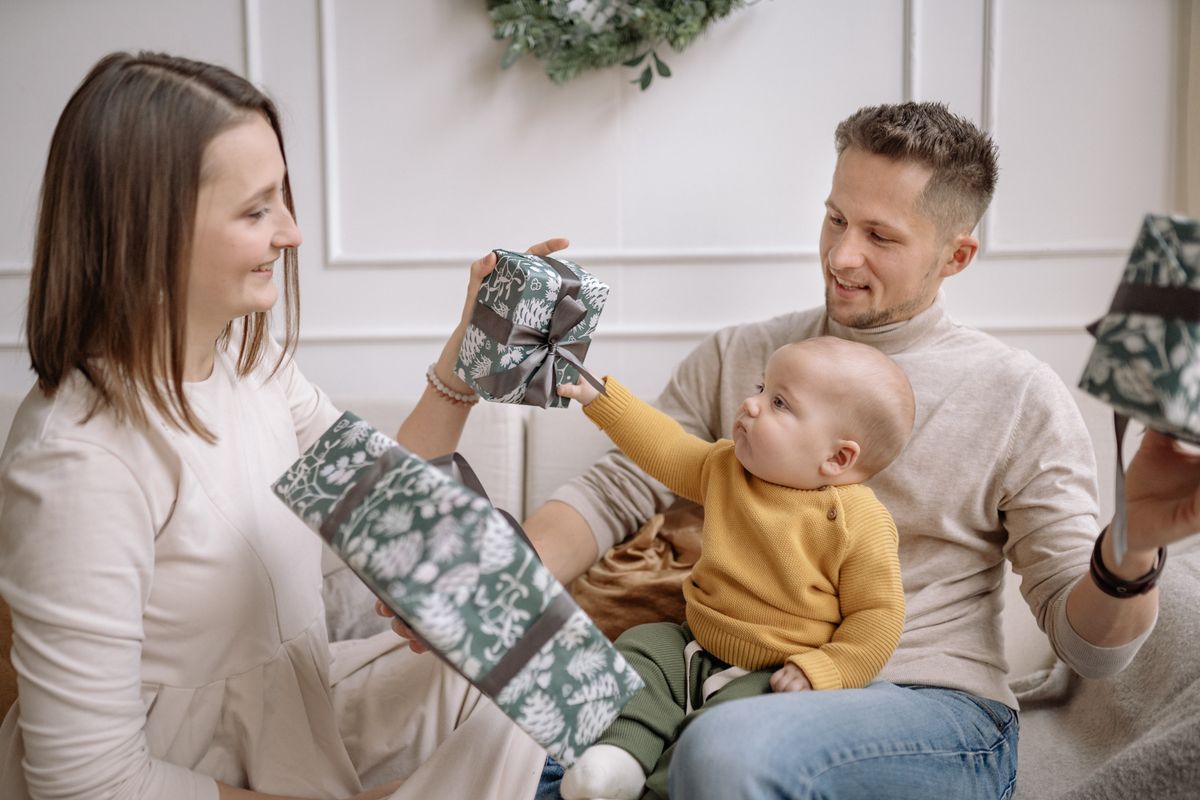
Two parents in one house, or a couple you are buying for jointly, create a specific problem: a shared gift can read as having bought one gift and split it.
Shared works when the thing is genuinely used together
A membership, a weekend, a dinner, a piece of furniture, a new set of bedding. These are consumed jointly, so nobody is receiving half of something.
Shared fails when one of them will use it and the other will not
A power tool, a coffee machine, a games console, a cookbook. Even where both say they are pleased, one of them has effectively received nothing. Buy the shared thing if you want to, then add one small, obviously individual item for the person who will not use it.
Keep the two gifts visibly separate when you wrap
Two parcels, two cards, two names. The administrative effort is trivial and the signal is not.
Frequently asked questions
The short version
For parents, upgrade something they use daily or give them time with you, and remove all the admin before you hand it over. For a spouse, copy the size and style from what is already in the wardrobe rather than guessing. And for the three categories these four people are most often given — jewellery, knitwear and leather — turn the item over and read what the label is required to say. The qualifier sitting immediately before the word diamond, the percentages on a fibre content label, and the difference between leather and bonded leather are all information you are entitled to before you pay, not after.
Some of the best gifts for parents and spouses are services rather than objects — a detail for the car, a season of lawn care, a job around the house taken off their hands. Those need a local business you can actually book. Ypages lists them free across all 50 states, and if you run one, adding your business is free too.
Sources
- Federal Trade Commission, In the Loupe: Advertising Diamonds, Gemstones and Pearls
- Federal Trade Commission, Threading Your Way Through the Labeling Requirements Under the Textile and Wool Acts
- Guides for Select Leather and Imitation Leather Products, 16 CFR Part 24