Published: September 2026 | Reading Time: 12 minutes
Here is the thing that changes how you should approach this: no US state licenses pet groomers as a profession. There is no state grooming board, no required training hours and no competency exam anywhere in the country. Anyone can open a grooming business tomorrow and describe themselves as a professional. That is not a reason to panic — most groomers are skilled and careful — but it does mean the checks that work for plumbers or electricians do not exist here, and you have to use different ones. This guide covers what you can actually verify, the handling questions that separate a good salon from a risky one, and the breed-specific risk most owners never think to raise.
There Is No Groomer’s Licence to Check
Unlike most trades covered on this site, grooming has essentially no occupational licensing. A 2026 industry guide from the Academy of Pet Careers puts it plainly: no state licenses dog groomers as a profession, and there is no state in the country with a grooming board, required training hours, or a competency exam for groomers.
A few places regulate the premises instead
Where regulation exists, it usually attaches to the facility rather than the person. Colorado is the clearest example, and its rules come straight from the state’s Department of Agriculture rather than an industry body.
Under the Pet Animal Care and Facilities Act, Colorado licenses groomer facilities as one of its pet animal facility categories. The fee is $400 for a primary, secondary, mobile or self-wash grooming facility and $350 for an independent contractor groomer, and licensing involves a pre-licence inspection in which the inspector examines the facility or vehicle along with all required records and documents. Colorado also publishes an active facility list, so you can check whether a business actually holds the licence it claims.
Other jurisdictions do smaller versions of this. Connecticut requires a facility licence to operate a grooming business, though with no exam and no training requirement attached. New York City requires a small animal grooming establishment permit with proof of insurance and a facility inspection.
| Jurisdiction | What is regulated | What it does not include |
|---|---|---|
| Most US states | Nothing grooming-specific | No board, no training hours, no competency exam |
| Colorado | Groomer facilities licensed under PACFA, with pre-licence inspection; $400 facility, $350 independent contractor | Not a personal competency licence |
| Connecticut | A facility licence to operate a grooming business | No exam, no training requirement |
| New York City | Grooming establishment permit, proof of insurance, facility inspection | Not a groomer qualification |
| Everywhere | General business registration, tax and zoning | Says nothing about skill with animals |
Read that right-hand column carefully. Even where regulation exists, it is almost always about the premises and the paperwork rather than whether the person holding the clippers knows what they are doing.
So the first practical step is simply to find out what, if anything, your own state or city requires — and if the answer is nothing, to adjust your expectations about what a business card proves.
Certification Is Voluntary, But It Is Real
With no licence to verify, voluntary certification does more work here than in almost any other trade. The best-known is run by the National Dog Groomers Association of America, and it is genuinely demanding.
What National Certified Master Groomer involves
The NCMG programme requires both written examinations and practical evaluations across four breed groups: Non-Sporting, Sporting, Long-Legged Terriers and Short-Legged Terriers. The written tests cover breed knowledge, grooming standards, and history and identification. The practical evaluations mean actually grooming dogs from each group within set time limits — a Poodle under 11 inches has an hour and a half, larger Poodles up to two and a quarter hours.
To earn NCMG status a candidate must average 85 percent across all written and practical tests, and participation in NDGAA workshops is required to complete certification. The American Kennel Club also offers a Professional Grooming Credential.
Treat certification as a strong positive signal rather than a requirement. Many excellent groomers never sought it, often because they trained through apprenticeship and have a full book without it. But it does demonstrate that somebody independent assessed their work against a standard, which is more than a website can tell you.
If your dog is flat-faced, say so when you book
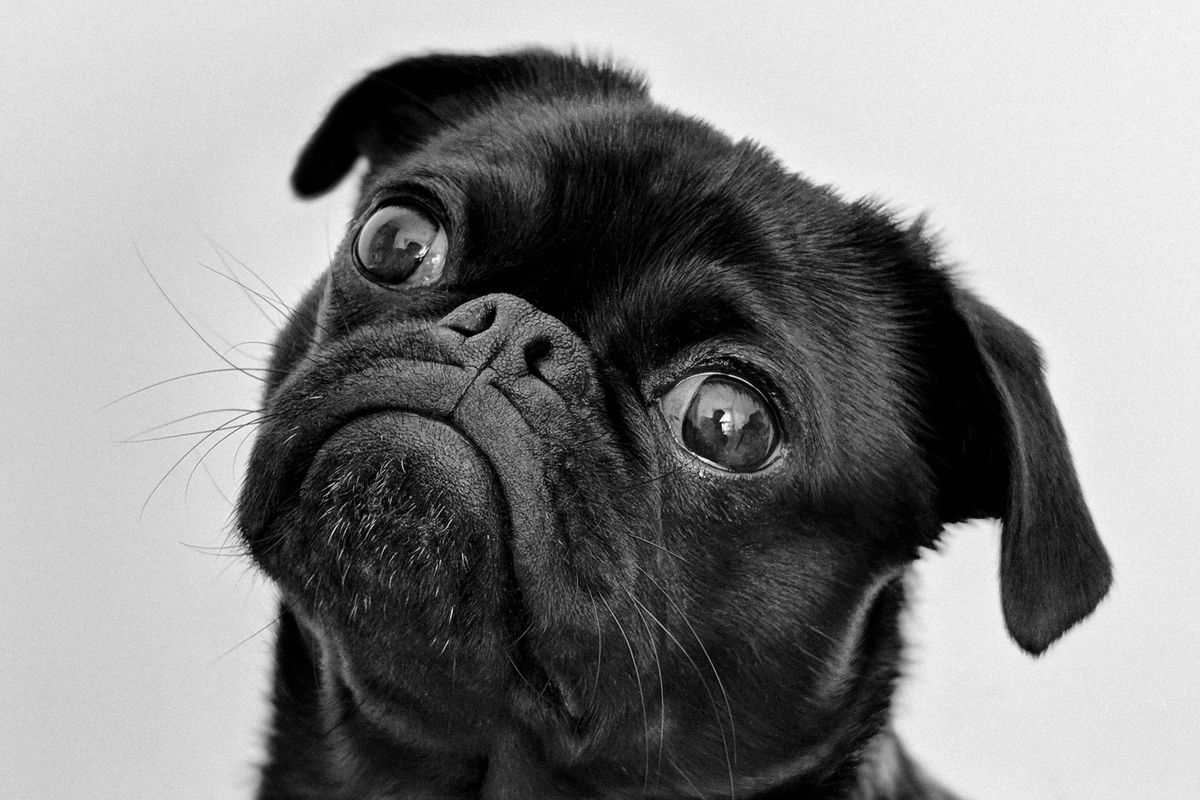
The AVMA explains that brachycephalic dogs — pugs, Boston Terriers, boxers, some mastiffs, Pekingese, Lhasa Apsos, Shih Tzus and bulldogs among them — have the same anatomical structures packed into a shortened nose, giving smaller-than-normal nostrils, a longer-than-normal soft palate and a narrowed trachea. The AVMA likens it to breathing through a straw that collapses when you suck hard. The consequence is that these dogs do not breathe efficiently and have difficulty cooling off when stressed or overheated, and under stress the airway can partially or completely collapse. A grooming appointment involves restraint, handling, warm water and drying — all stressors. Tell the groomer the breed when you book and ask specifically how they manage heat and stress for flat-faced dogs.
The Drying Question
Drying is where most of the heat risk in a grooming appointment sits, and it is the part owners almost never ask about because they are not in the room for it.
What to ask
- How is my dog dried? Hand-dried with a handheld dryer, in a kennel with a forced-air dryer, or with a heated cage dryer are three different answers.
- Is a dog ever left unattended while drying? This is the question that matters most, and the answer should be no.
- Do you use heat, and how is the temperature monitored?
- How long will my dog be at the salon in total? A long wait in a kennel before or after the groom is part of the stress load.
- What do you do differently for a flat-faced, elderly or heat-sensitive dog?
A groomer who answers these readily and in detail is one who has thought about it. Irritation at being asked is itself the answer.
Visit Before You Book
Because there is no licence and no inspection report to read in most places, seeing the premises does more work here than almost anywhere else.
| Look at | What it tells you |
|---|---|
| Whether you are allowed in at all | Some salons restrict access for good reasons; blanket refusal to show you anything is different |
| Smell and cleanliness | A working salon smells of wet dog. It should not smell of urine |
| Kennels and holding areas | Size, ventilation, whether water is available, how many dogs are waiting |
| Whether dogs are ever left alone on a table | A dog in a grooming noose unattended is a fall and strangulation risk |
| Noise level and the dogs’ body language | Some barking is normal; sustained panic is not |
| How staff speak to and handle animals | The single most informative thing you will observe |
Go at a busy time rather than first thing. A salon at two in the afternoon with a full board shows you how it copes under pressure, which is the condition that matters.
Paperwork and Practicalities
Things to confirm before the first appointment
- Insurance. Ask whether they carry liability insurance covering injury to animals in their care, and ask to see it rather than take the word.
- Vaccination requirements. A salon that requires proof of vaccination from every client is protecting your dog as much as imposing on you. No requirement at all is worth noticing.
- What happens in an emergency. Which vet do they use, will they call you first, and who authorises treatment?
- Who actually grooms your dog. At larger salons the person you meet may not be the person with the clippers.
- The policy on matted coats. A responsible groomer will shave rather than dematt a severely matted dog, and should tell you before doing it.
- Cancellation and late fees, so the first invoice holds no surprises.
On matting: it is worth understanding in advance that a badly matted coat cannot be brushed out humanely, and that a short clip is the kind option rather than a failure. A groomer who explains this before starting is doing their job; one who silently shaves the dog, or one who spends two hours pulling at mats, is not.
Start Small and Watch What Comes Back
The best test of a groomer is not the consultation. It is the first appointment and the state your dog is in afterwards.
Book a bath and tidy first
Rather than committing to a full breed trim with a stranger, book something short — a bath, nail trim and tidy-up. It costs less, keeps your dog there for less time, and gives you a real sample of their handling and their communication before anything irreversible happens to the coat.
What to check afterwards
- Your dog’s demeanour. Tired is normal. Frightened, or reluctant to go back next time, is information.
- Nicks, clipper burn or razor irritation, especially around the belly, armpits and paws.
- Ears and nails — were they actually done, and done carefully?
- Whether they told you anything. A good groomer volunteers what they noticed: a lump, a sore ear, a sensitive spot. They see your dog’s skin more closely than you do.
That last point is the strongest sign of a groomer worth keeping. Someone who mentions a lump they felt near the shoulder is treating your dog as an animal in their care rather than a job on a list.
The broader principle is the same one that applies to any service where you hand something valuable over and leave — verify what you can, ask direct questions, and start with something small. Our guide to finding a reliable tradesperson applies the same approach to work on your home.
Frequently Asked Questions
Sources
- Colorado Department of Agriculture — PACFA Licensing, including groomer facilities
- National Dog Groomers Association of America — NCMG Program
- American Veterinary Medical Association — Short-nosed dogs and breathing difficulty
- The Academy of Pet Careers — 2026 guide to dog groomer licensing by state
This article is general information, not veterinary advice. Regulations vary by state and city, and any concern about your pet’s health or a specific breed risk should go to your veterinarian.