

Published: September 2026 | Reading Time: 13 minutes
Choosing childcare is the highest-stakes hiring decision most parents ever make, and it is usually made under time pressure with incomplete information. The good news is that more of it is checkable than people realise. Federal law requires states to publish child care inspection reports online, the American Academy of Pediatrics publishes specific staff-to-child ratios you can hold a programme to, and there is a national accreditation you can verify independently of state licensing. This guide covers those checks, what to look for on a visit, and the questions that reveal how a programme actually runs.
Start With Licensing and Inspection History
This is the step that is both most informative and most often skipped, and it costs nothing.
The reports are public, by law
Childcare.gov states that federal law requires states and territories to post the results of child care monitoring and inspection reports online. Licensing staff must make regular onsite, in-person visits to monitor and inspect all licensed programmes, checking that they continue to meet licensing requirements.
You can find those reports by selecting your state or territory on Childcare.gov and reviewing its “Understanding and Finding Child Care Resources” page. A report should document health and safety violations if any, the actions the programme took to correct them, and the actions the state took to address them.
How to read what you find
A single violation is not automatically disqualifying — what matters is the pattern and the response. Read for: whether violations repeat across visits, whether they are administrative or health-and-safety, whether corrections were made, and whether any complaints were substantiated, meaning the state investigated and found them valid.
Childcare.gov’s own sequence is worth following in order: learn the basics, search using your state’s online child care search tool, investigate licensing status and inspection reports, contact each programme, visit several, then weigh everything together — including whether the children looked happy and engaged in age-appropriate activities.

Know the Ratios Before You Walk In
Staff-to-child ratio and group size are the two numbers that shape almost everything else — how much individual attention a child gets, how quickly a problem is noticed, and how exhausted the staff are by three in the afternoon.
What the AAP recommends by age
State licensing minimums vary and are often more permissive than what paediatricians recommend. These are the American Academy of Pediatrics figures, and they give you something specific to ask about.
| Age | Child-to-staff ratio | Maximum group size |
|---|---|---|
| Up to 12 months | 3:1 | 6 |
| 13–35 months | 4:1 | 8 |
| 3 years | 7:1 | 14 |
| 4 years | 8:1 | 16 |
| 5 years | 8:1 | 16 |
| 6–8 years | 10:1 | 20 |
| 9–12 years | 12:1 | 24 |
Group size matters independently of ratio. Two staff with twelve toddlers is the same ratio as one staff with six, but a very different room to be a two-year-old in. Ask for both numbers, then count heads yourself while you are standing there.
The single best sign of a good programme
The American Academy of Pediatrics says parents should be able to visit before enrolling and then visit anytime the programme is open. A provider who welcomes unannounced visits from parents is making a standing claim about what happens on an ordinary Tuesday. One who requires appointments, restricts visits to certain hours, or discourages dropping in is telling you something important — whatever reason is offered. Ask this question early, because the answer reframes everything else you are told.
Accreditation Goes Beyond Licensing
Licensing is a floor — the minimum a programme must meet to operate legally. Accreditation is voluntary and sits above it.
The National Association for the Education of Young Children runs the best-known programme. Accredited programmes have met NAEYC’s ten standards for high-quality early childhood education, providing evidence on safe environments, well-trained teachers, quality materials and developmentally appropriate curricula — covering positive relationships, curriculum, qualified staff, family partnerships and management policies among them.
Why it is more than a logo
Two things make it meaningful rather than decorative. The process involves an extensive application review followed by on-site assessor visits, and accredited programmes are subject to random, unannounced visits by assessors to confirm continued compliance. And you can check it yourself: NAEYC publishes an accredited programme search, so the claim is verifiable rather than a logo on a website.
Treat it as one signal among several. Plenty of excellent programmes are not accredited, often because the process is demanding for a small operation. But a programme claiming accreditation it does not hold is a different matter entirely, and takes two minutes to check.

If You Have an Infant, Ask About Sleep
For babies, this is the most important conversation you will have with a provider, and it deserves specific answers rather than reassurance.
The safe sleep practices CDC sets out apply in any caregiving setting. Babies should be placed on their back for all sleep times, naps included. The sleep surface should be firm and flat — not at an angle or inclined — for example a mattress in a safety-approved crib covered by a fitted sheet. Soft bedding should be kept out of the sleep area entirely, including blankets, pillows, bumper pads and soft toys. And a baby’s head should not be covered, nor should the baby be allowed to get too hot.
What to ask, and what to look at
- Ask to see the sleep room during nap time, not just an empty room on a tour.
- Look at what is in the cribs. A fitted sheet and nothing else is what you want to see.
- Ask whether there is a written safe sleep policy, and ask to read it.
- Ask how every staff member is trained on it, including relief and part-time staff.
- Ask what happens if a baby falls asleep somewhere else — in a swing, a bouncer or a car seat.
A provider who answers these precisely and without defensiveness has thought about it properly. Vagueness here is not a small thing.
Staff Are the Programme
Buildings and curricula matter far less than the specific adults in the room, which makes turnover one of the most revealing things you can ask about.
Questions the AAP suggests
- What education and training do the staff have? Ask what professional development they have completed recently, not just at hiring.
- Are they CPR certified? A direct question with a direct answer.
- How long have they been here, and what experience do they have with my child’s age group?
- Are enough trained adults available on a regular basis, and how are absences covered? Substitutes are where ratios quietly slip.
- Is there a qualified health professional involved? The AAP notes centres should have one such as a doctor or nurse, with infant-toddler programmes receiving monthly visits and other programmes quarterly.
- How are visitors screened so that only approved adults can visit and collect children?
Ask the turnover question of the staff, not only the director: “how long have you worked here?” put to two or three people in the room tells you more than any policy document.
What to Watch on the Visit
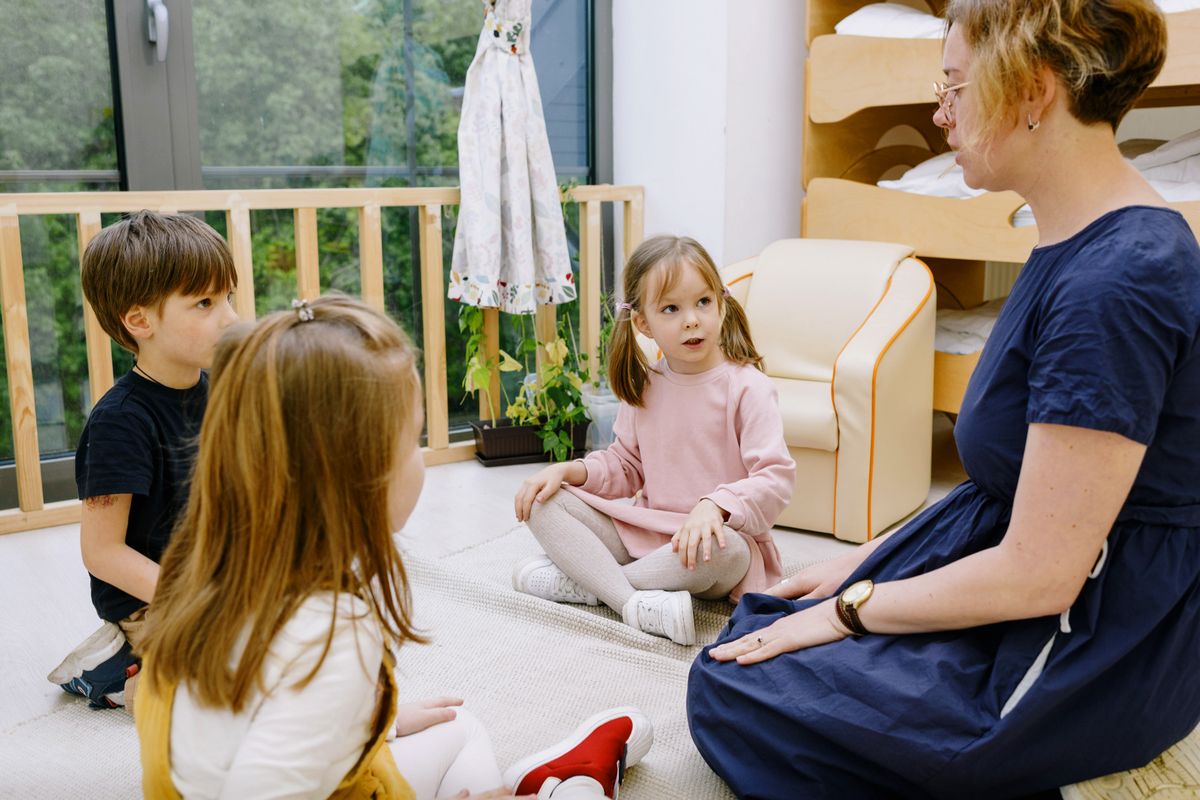
Childcare.gov recommends visiting several programmes and using its “Look, Listen, and Ask” tip sheet while you are there. Beyond the checklist, a few things are worth deliberately watching for.
| Watch for | What it tells you |
|---|---|
| Are staff down at the children’s level, or standing over them? | How interaction actually works when nobody is performing |
| What happens when a child is upset? | The single most informative thirty seconds of a visit |
| Do staff speak to children by name, warmly? | Whether the room is a relationship or a queue |
| Are the children engaged, or parked in front of a screen? | Whether activities are age-appropriate and intentional |
| Does the room sound busy or chaotic? | Busy is good. Chaotic, or oddly silent, is worth asking about |
| Is handwashing happening — after nappies, before food? | The most basic infection control, and easy to observe |
Go back at a different time of day
Visit more than once if you can, and at different times. A drop-off at eight in the morning and a late afternoon at half past four look like different places, and the late afternoon is usually the more honest one.
A Process That Fits Into Real Life
Most parents are doing this while working and often while pregnant or on limited leave. This order keeps the effort proportionate.
- Use your state’s online child care search tool to build a long list near home or work.
- Check licensing status and read the inspection reports before contacting anyone. This eliminates candidates fastest.
- Check accreditation for any programme claiming it.
- Phone the remaining programmes about availability, hours, cost, and whether parents may visit any time they are open.
- Visit at least three, ideally including one late-afternoon visit.
- Ask the ratio and group size in each room your child would be in, then count.
- Weigh it all together, including how comfortable you felt and whether the children seemed happy and engaged.
And once your child starts, keep visiting. The right to drop in is only worth something if you use it.
Frequently Asked Questions
Sources
- Childcare.gov — Simple Steps for Finding and Choosing Child Care
- Childcare.gov — Monitoring and Inspections
- American Academy of Pediatrics, HealthyChildren.org — Choosing a Child Care Center
- NAEYC — The Value of a NAEYC-Accredited Program
- Centers for Disease Control and Prevention — Providing Care for Babies to Sleep Safely
This article is general information, not medical or legal advice. Licensing rules and ratio requirements vary by state — check your own state’s regulations, and speak to your paediatrician about your child’s specific needs.